• As schools grapple with the challenges of implementing policy, pedagogy and practice around SEMH , they should certainly look at the potential offered in Books Beyond Words. Don’t be put off by the fact that there are no words! These books allow the emotional centres of the brain to express deep and complex emotions . They will be especially useful for a range of children and young people with SEND. The story format of each books  encourages emotional expression , and facilitates resolution to emotional issues that children with Autism , for example, do not find easy to decode.
    There are a range of books that particularly support Personalised Learning too. Topics that we may find difficult to articulate to the child, or for which the bog standard leaflet has no relevance, (e.g., managing Type 1 Diabetes) are powerfully expressed through the medium of pictures, in a way that is comprehensible and informative to the child with SEND.
    I have work with the Team at Books Beyond Words to classify from their catalogue those books most relevant to SEMH, and Personalised Learning . They will enrich our curriculum journeys in these areas considerably.
  • Discount offer from Routledge on books by Professor Barry Carpenter

    Screenshot 2016-02-04 19.59.04

  • The experiences of family carers in the delivery of invasive clinical interventions for young people with complex intellectual disabilities: policy disconnect or policy opportunity?

    This is a little discussed topic , but one that faces many families of children and adults with an complex learning difficulty and disability.

    Authors:Michael Brown, Louise Hoyle and Thanos Karatzias

    Click thumbnail image below to download and view this article:

    Screenshot 2016-02-03 10.31.41

  • See link below:
     
    Article just published: Jones, P.; Churilla, I.; Demes, A.; Sadlo, R.; Sweeney, M.; & Pastore, H. (2015). Finding Ferdy: A Collaborative Inquiry About a Student with Complex Disabilities, The Canadian Journal for Teacher Research, 3.
  • Attached is a nasen SPECIAL in which an article on Autism and Girls appeared.

    See extracted article below “Time for a rethink.”

    (Click thumbnail image below to open as .pdf)

    Girls with Autistic Spectrum Condition [ASC]


    Nasen, SEN Facts And Figures – ‘Time For A Rethink’ NASEN.ORG, 2015. full – special_extra_junel_2015_second pp (2)


  • The new generation of children with special educational needs and disabilities (SEND), those with complex learning difficulties and disabilities (CLDD), have transformed the special needs registers of our schools in this first part of the 21st century (Carpenter et al., 2015). Many of these children are ‘wired differently’; children born prematurely, particularly those of pre-28 week gestation, are a particular example of this phenomenon (Carpenter and Egerton, 2013). Their profile of learning is not that which we have previously known with children with SEND. This brings unique challenges to teachers, for the neural pathways in the brain of the child with CLDD are connected and routed differently, and they, thus, learn differently. Therefore, in what ways do we teach differently?

    This is a debate that is beyond differentiation, and takes us into the realms of new generation pedagogy, where personalisation becomes an essential component of the differentiated process of meeting individual needs.

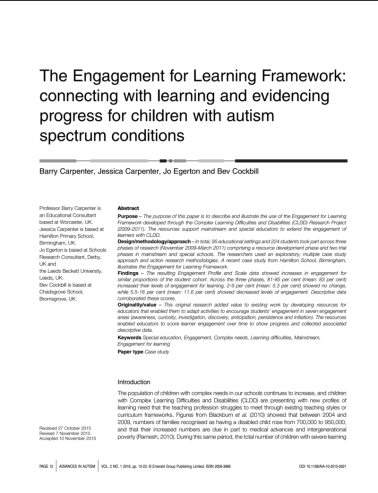
    Key to this pedagogy – ‘how’ we teach – is engagement (Carpenter et al., 2015). For any child of any ability without authentic engagement in learning there will be no meaningful outcomes, no effective progress, no real attainment. Engagement is the liberation of intrinsic motivation and the pathway to achievement. The engagement principle, delivered through the Engagement Profile and Scale (http://complexld.ssatrust.org.uk), enables a teacher to co – produce with the child, a truly responsive learning programme. This will style itself in ways appropriate to the presentation of the child’s complex needs. Autism, for example, is not merely the ‘classic’ presentation we knew in the late twentieth century, but now has multiple causal bases, all of which generate specific learning styles. Again, engagement can be key to ensuring high quality, responsive teaching (Carpenter et al., 2016).

    From the extensive Department for Education-funded research conducted in the UK by Carpenter and colleagues, a range of resources were produced and are located on http://complexld.ssatrust.org.uk. Similarly the 16 modules written to support teacher training in the area of complex needs – ‘Training Materials for Educators of Learners with Severe, Profound and Complex Learning Difficulties’ (www.complexneeds.org.uk) – are now the focus of a European Commission-funded Erasmus+ programme to make these materials more widely available in Europe via a number of European languages to support inclusion practice through accredited vocational learning.

    Our challenge in this 21st Century is to create inclusive pedagogy, regardless of setting. There are children entering our schools ‘the likes of which we have never seen before’. Engagement, as a well-researched principle for learning in all children, will be key to that inclusive pedagogy. We need to design a curriculum which wraps around the child with CLDD (Carpenter et al., 2011), and takes that child on a journey of effective teaching to enable us to touch that child at their point of learning need.

    Professor Barry Carpenter, January 2016

    References

    Carpenter, B., Carpenter, J., Egerton, J. and Cockbill, B. (2016) ‘The Engagement for Learning Framework: Connecting with learning and evidencing progress for children with autism spectrum conditions’, Advances in Autism, 2 (1).

    Carpenter, B. and Egerton, J. (2013) ‘The impact of prematurity on special educational needs’, Optimus Education (SEN hub). [Online at:http://www.optimus-education.com/impact-prematurity-special-educational-needs; accessed: 7.10.13]

    Carpenter, B., Egerton, J., Brooks, T., Cockbill, B., Fotheringham, J. and Rawson, H. (2011) The Complex Learning Difficulties and Disabilities Research Project: Developing meaningful pathways to personalised learning (project report). London: Specialist Schools and Academies Trust (now The Schools Network). [Online at:http://complexld.ssatrust.org.uk/project-information.html; accessed: 21.3.12]

    Carpenter, B., Egerton, J., Cockbill, B., Brooks, T., Fotheringham, J. and Rawson, H. (2015) Engaging Learners with Complex Learning Difficulties and Disabilities: A resource book for teachers and teaching assistants. Abingdon: Routledge.

  • This article is available for free download from www.isei.washington.edu

    Coaching Conversations in Early Childhood Programs: The Contributions of Coach and Coachee
     
    Gayatri Jayaraman, MEd; Christine Marvin, PhD; Lisa Knoche, PhD; Sue Bainter, MA 
    Studies to date have linked early childhood (EC) coaching to child, family, and teacher outcomes but have not investigated “what” is happening in a coaching conversation. This exploratory study specifically unpacks nuances associated with the coaching conversation process and associations between the EC coaches’ behaviors and coachees’ participation during conversations. The results highlight conversation behaviors used by both EC coaches and coachees and how these behaviors may be associated with each other in building partnerships and promoting collaborative practices.
    The conversational behaviors of 24 EC coach–coachee dyads were investigated by reviewing videotaped sessions of their meetings using a reliable Early Childhood Coaching Conversations coding system. Results indicated much variability in the use of conversation behaviors.
    Bivariate correlations provided a hint of possible conversation behaviors associated with relationship building and a “shared ownership” process during coaching conversations. Implications for future work in research and practice are discussed.
  • When a child has Complex Learning Needs , there is no ‘quick fix’. The teacher will need to investigate, explore, search , to find out more about the styles of learning that will be effective in truly engaging the child. This is a process of Inquiry , that goes hand in hand with evidence based practice.
    This was an inherent component of the national Complex Learning Difficulties and Disabilities Research Project in the UK, – (http://complexld.ssatrust.org.uk)

    This new article by Dr Phyllis Jones and colleagues exemplifies how the process of Engagement , as the basis for effective pedagogy, links collaboratively with the Teacher process of Inquiry .

    Article just published: Jones, P.; Churilla, I.; Demes, A.; Sadlo, R.; Sweeney, M.; & Pastore, H. (2015). Finding Ferdy: A Collaborative Inquiry About a Student with Complex Disabilities, The Canadian Journal for Teacher Research, 3,

    http://www.teacherresearch.ca/blog/article/2015/12/27/283-finding-ferdy-a-collaborative-inquiry-about-a-student-with-complex-disabilities.