A new article for UKEdChat at GL Assessment:
http://ukedchat.com/2016/03/06/dealing-with-childrens-mental-health-issues-as-a-teacher/
A new article for UKEdChat at GL Assessment:
http://ukedchat.com/2016/03/06/dealing-with-childrens-mental-health-issues-as-a-teacher/
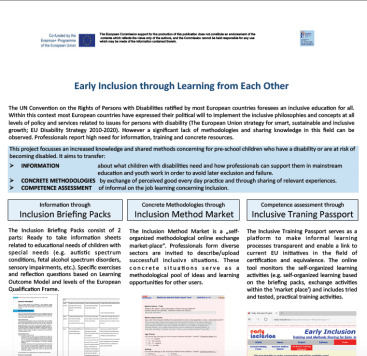
The UN Convention on the Rights of Persons with Disabilities ratified by most European countries foresees an inclusive education for all. Within this context most European countries have expressed their political will to implement the inclusive philosophies and concepts at all levels of policy and services related to issues for persons with disability (The European Union strategy for smart, sustainable and inclusive growth; EU Disability Strategy 2010-2020). However a significant lack of methodologies and sharing knowledge in this field can be observed. Professionals report high need for information, training and concrete resources. Early- Inclusion, is an Erasmus Plus Project through the European Union (www.early-inclusion.eu).
The UK is involved through, and represented by, Chadsgrove Teaching School (contact: Bev Cockbill – bac42@chadsgrove.worcs.sch.uk). Professor Barry Carpenter (UK) is the Lead Consultant to the Project, and has contributed to its design, and initial research and development approaches.
The poster below outlines the preliminary work of this Project, which has a particular focus on the development of Teaching Assistants, (and similar) in a variety of education and childcare settings.
Please click the thumbnail below to open and view the poster in full.
Pica is often a misunderstood, or as a little known condition in children with developmental disabilities, but it can have a devastating effect on their learning and quality of life. The article below raises some of the key issues in an informative and relevant way.
Click the thumbnail below to open and download the full article.

Below is an article produced by Karam Bhogal, a former Schools Direct student with Professor Carpenter , describing the use of the Engagement Profile and Scale ( EPS ), with children with Complex Learning Difficulties and Disabilities.
Click thumbnail image below to open & view PDF.

Even though mental illness can be more common among autistic people than the general population, the mental health of people on the autism spectrum is often overlooked.
The National Autistic Society provides a range of information and advice on dealing with mental health issues and anxiety, which can be found on our website.
The NAHT Special Schools, Specialist and Alternative Provision Conference 2016 theme is Promoting wellbeing for children, young people and staff (Thursday, 10th to Friday, 11th March, 2016) at The Hinckley Island Hotel, Leicestershire) .The link to the full conference description http://www.naht.org.uk/welcome/naht-events/conferences/send-conference-2016/)
Discount offer from Routledge on books by Professor Barry Carpenter


 Barry Carpenter Education