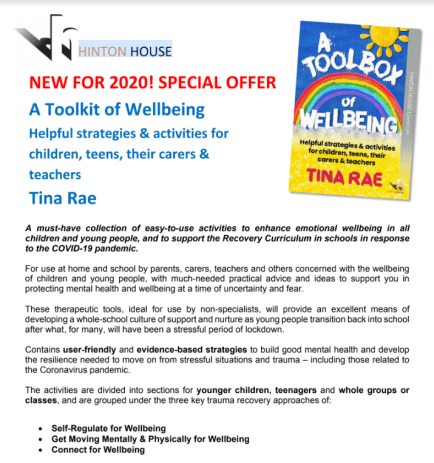
• A Toolbox of Well Being – Dr Tina Rae

    Highly recommended, as schools plan their Recovery Curriculum. Rooted in a secure evidence base, this book offers lots of practical suggestions for teachers as they support children’s return to school, and life after lockdown. There is a strong rationale and educational model for the activities, and I recommend it over some of the spurious materials being put out for commercial interest currently.

    http://www.hintonpublishers.com/isbn_template.php?isbn=978-19-12112-55-5&x=73&y=84


  • Watch this incredible video clip of FE Tutor Leigh Blakeman, (Chadsgrove College, Bromsgrove) carrying out some home teaching using books beyond words with two students with PMLD from their 19-25 provision. As ever, we are reminded of the power of communication, in whatever form it comes.

    https://youtu.be/aADV-miuu7M

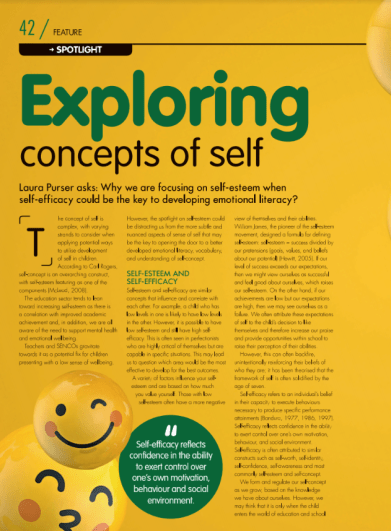
  • As children return to school , ‘Concepts of Self‘ will be of paramount importance.

    This article by Laura Purser offers a brief explanation of the key concept of self esteem, but also why self efficacy is vital too.

    PDF Download Icon

  • Lenny and Lucy coming August 2020

    School closures have been one of the biggest disruptions caused by the coronavirus pandemic. For most children, lockdown has meant a loss of routine, structure, friendship, opportunity and freedom. Some may even have lost loved ones.

    If you’re a teacher or parent you will already be thinking about how you’re going to support the children in your care to settle back into their daily school routine after such a long break and so much change.

    We’re working with Prof Barry Carpenter CBE and teachers Alison Erskine and Jenny Hawkes to develop two new stories to support all primary school children – mainstream and SEN – in their return to school. Lenny and Lucy in Lockdown and Lenny and Lucy Return to School will help children make sense of their experiences, communicate their feelings and prepare for more change as they go back to the classroom – and they will be available completely free of charge.

    Both stories will be available in time for the new school term. To receive an alert when they are published, sign-up to our mailing list.

    “Following ‘lockdown’, with children now returning to their schools, teachers know that every child in their class will need time to talk. Each child’s experiences will need to be shared and acknowledged. These wordless stories are a unique way to help children recall and tell their own story of lockdown and to talk about their emotions and feelings as they return to school and begin their journey of recovery.”
    – Jenny Hawkes; Assistant Head, Whitfield Aspen School

    “The strength of these wordless stories is the ease at which they can be used with all primary aged children. They can be used to stimulate a whole class discussion, as a small group activity or with an individual child. Lenny and Lucy’s experiences are a prompt for all children to tell their own stories, regardless of their communication abilities. Adults are able to listen, acknowledge and reassure the children, helping them articulate what they are feeling and make sense of what is happening as they return to school.”
    – Ali Erskine; Head of School for KS1, Whitfield Aspen School

    “Children have had their world turned upside down by the pandemic; many are angry and confused, carrying lots of unprocessed information. These books will offer opportunities for children to recall those experiences, and, in so doing tell, ‘their’ story. The books make a unique contribution to the Recovery Curriculum of any school, and to its overall curriculum work in Social, Emotional and Mental Health.”
    – Prof Barry Carpenter CBE


  • As Teachers begin to think about the return to school for the new term, they will be concerned about how their pupils will have processed, or not, the experience of lockdown and the pandemic generally.

    Many will consider trauma informed practice in their repertoire of responses to child need.

    In this Guest Blog, Laura Purser, who leads the Masters level SENCO training at the University of Buckingham, and is Head of Primary and Early Years teacher training there, discusses why this is invaluable as a lens for viewing the recent experiences of children.

    https://educationblog.buckingham.ac.uk/2020/07/08/transforming-trauma-by-laura-purser/

    Click here, or the cover image below to view.

  • Salesforce email header

    Having-a-COVID-Test---promo

    As lockdown measures ease, testing is more important than ever for controlling the spread of coronavirus. We felt, however, that more was needed to support people with learning disabilities and autism to understand what testing involves, how it feels and subsequently to prepare and give informed consent.

    Working with Lucy Bergonzi who illustrated Beating the Virus, we’ve published: Having a Test for Coronavirus. The new story illustrates both a drive through testing centre and a home test, so that a person can decide which option is right for them and prepare. We’ve also published a shorter version of the story which shows just the home test option, as well as an A4 picture sheet illustrating just the drive through testing process. On the reverse of the picture sheet there is information for health professionals/ testers on how to make the test accessible.

    As with all our coronavirus support resources, these are all completely free to download from our website:

    https://booksbeyondwords.co.uk/coping-with-coronavirus/#testing
    Please spread the word about these new resources and pass them on to anyone who may find them helpful.

  • “A spike in fetal alcohol harm could be a potential negative outcome of the COVID-19 lockdown because of alcohol consumption combined with being home-bound, feelings of extraordinary stress or fear, and restricted access to contraception.”

    Read more about this , and other related articles, in Lancet Public Health. 2020 (July)
    https://www.ncbi.nlm.nih.gov/pmc/articles/PMC7363422/

  • The Department for Education, in collaboration with NHS England and Public Health England, hosted this free webinar for school and college staff on 9 July on how to support returning pupils and students mental wellbeing. You will hear from experts on the impacts of the pandemic on children and young people’s mental wellbeing and recovery techniques, and from education leaders about the actions they have been taking.

  • On Tuesday 14th July, Professor Dame Alison Peacock, CEO of the Chartered College of Teaching, awarded Professor Barry Carpenter with a Fellowship of the College for his distinguished service to Education.

    https://my.chartered.college/2020/07/webinar-a-recovery-curriculum-reconnection-re-igniting-and-resilience/