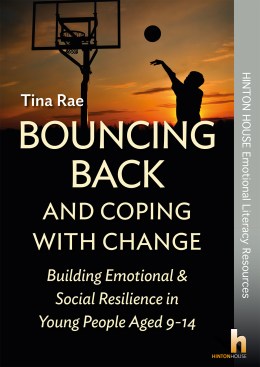
£29.99 169pp A4 photocopiable paperback ISBN 978-1-906531-76-8

Buckingham; Hinton House

Published 2016
At this time of significant focus and concern about the mental health needs of young people in Britain (as evidenced by the Heads Together campaign www.headstogether.org.uk – led by the Duke and Duchess of Cambridge), practical resources that empower teachers to create dynamic curriculum responses are very welcome. Yet again, Tina Rae provides us with such a resource.
In a well-scripted Introduction, Dr Rae scaffolds some key constructs, which build the evidence-base for the subsequent teaching and learning strategies offered in this text. I was particularly taken with her section on ‘The Importance of Positive Emotions.’ Pulling on the seminal work of Seligman, she offers a tried interpretation, in the classroom context, of hope and optimism, flow and happy memories.
Whilst the first and last may have obvious interpretations, it is the concept of ‘flow’ that struck me as having pedagogical relevance to classroom dynamics. Flow is defined as ‘a sense of deep engagement in an activity during which time passes extremely quickly and the individual is able to work at full capacity.’ Engagement is a major platform for building responsive pedagogy in this 21st century (Carpenter et al, 2015), and here the antidote of full authentic engagement in challenging, meaningful learning is pitched against anxiety arising from feelings of disenfranchisement in an alien curriculum.
“Young people are frequently flooded with anxious and negative thoughts and doubts “ states, Tina Rae, and rightly shows how this can lead to a rapid disintegration of their emotional well-being. Cognitive Behavioural Therapy (CBT), has become a popular therapy for assisting in the restructuring of thought processes, by examining the interface between emotions and our behaviours. Schools will have known of children receiving CBT to promote positive mental health, but it was something carried out by the Psychologist or CAMHS worker. There was no curriculum context for this intervention, and the key tenets were never fully articulated in terms of teaching and learning.
Through a range of photocopiable resources and activities ‘Building Positive Thinking Habits’ goes on to do just that! It confronts the negativity, particularly around self image, that pervades the teenage years of so many young people. Bombarded by destructive negative thoughts and influences from so many angles, a rapid erosion in the mental health state can quickly occur, and direct interventions are crucial. This is where activities such as NATS and PATS can be useful and relevant. How can the power of Positive Automatic Thoughts (PATS) overcome Negative Automatic Thoughts (NATS)?
All of the activities outlined would be of great value to the teachers (as part of tutor time), to SENCOs (for designing specific interventions) and for Teaching Assistants who are often delegated to implement those interventions. Ultimately the ‘Solutions-Focussed Mind’ is the key to increasing self-confidence and resilience in young people. Whilst CBT is only one approach currently available, at long last we have a resource book that explains to teachers what it is, and how it can be useful in schools as a valid, evidence-based intervention, which has a distinctive contribution to make for all Young People.
Professor Barry Carpenter, CBE, Ph.D.
International Educational Consultant September 2016
https://www.amazon.co.uk/Building-Positive-Thinking-Habits-Self-Confidence/dp/1906531765

http://www.hintonpublishers.com/isbn_template.php?isbn=978-1-906531-76-8