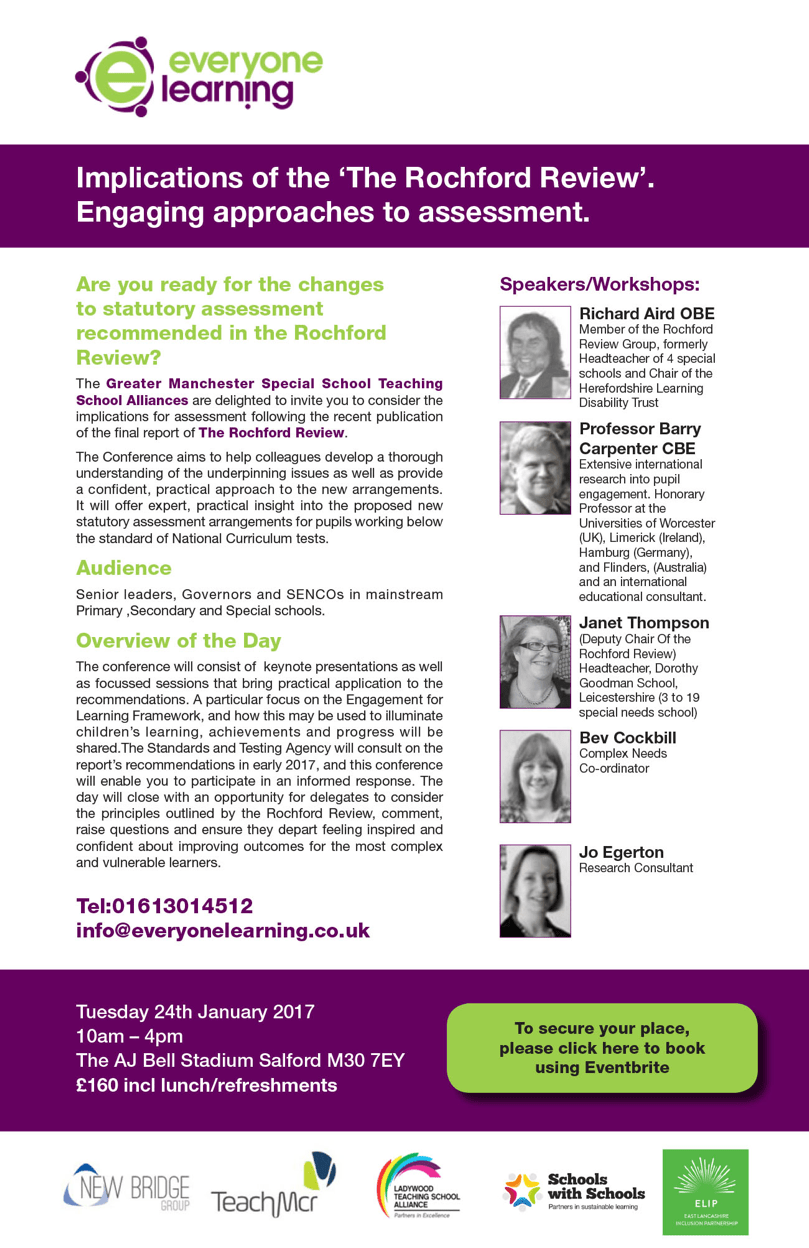
Read the first blog post on the new E4L – Engagement4Learning website.
Written by Professor Barry Carpenter.
Related Content:
Engaging Learners with Complex Learning Difficulties and Disabilities – (2015)
A two-day Forum, dedicated to the memory of Penny Lacey on the 2-3rd March 2017 at the Swiss Cottage School Conference Centre, London.
Full details in the downloadable flyer below!

Diane Rochford, the Chair of the Government’s Review on Assessment for children with SEND, has endorsed the popular book:
“Engaging Learners with Complex Learning Difficulties and Disabilities:A resource book for teachers and teaching assistants, (Routledge)”
“In the light of Government reforms in the assessment of children with SEND this is extremely timely. The book is profoundly significant in that it does what teaching was meant for and that is to place the child at the heart of learning”
– Diane Rochford
Acknowledging that the book is being widely used by Teachers and others in a variety of settings , the publishers are offering a 20% discount for a limited period. (see below):
This book is available to purchase direct from Routledge:
Click the thumbnail below for the review and discount details:

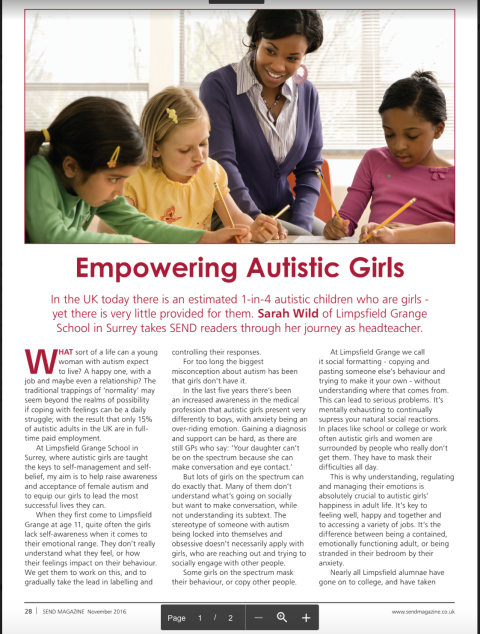
This new article by Sarah Wild, Headteacher of Limpsfiled Grange school Surrey, looks at strategies for empowering girls on autism spectrum.
Click image below to view full .pdf
New article: ‘Let’s Talk Autism’ -a school-based project for students to explore and share their experiences of being autistic
Kathryn Stevenson, Katie Cornell and Vivian Hinchcliffe
Understanding what autism means on a personal level can be an important process for young people on the autistic spectrum, and being able to reflect on this and discuss with autistic peers can be particularly helpful. However, opportunities may be restricted by reluctance to talk about diagnosis and because of difficulties in communication inherent in autism. This article describes a therapeutic media project within an ASD school that attempted to support young people to reflect together about what autism meant for them and create resources to share with others.
The process is described and main themes of discussions analysed using thematic analysis. Main themes emerged of making sense of diagnosis, experiences of difference and transition to adulthood. Various strategies to manage diagnosis and negotiate identity also emerged. Issues around informed consent and confidentiality and the therapeutic value of such groups are discussed.


In this latest issue of the SEND magazine there are articles on Girls with Autism Spectrum, and Mental Health in children with SEND.
https://issuu.com/sendmagazine/docs/send_november_2016_v04_digital
Click to view full .pdf flyer


Nasen, the UK’s leading organisation supporting those who work with or care for children and young people with special and additional educational needs and disabilities (SEND), has launched a free miniguide to supporting girls with autism spectrum conditions/disorder (ASC/ASD).
Girls and Autism: Flying under the radar, is a 20-page full-colour guide designed to alert busy teachers to the hidden struggles of girls with ASC/ASD. Misunderstanding of their support needs, it suggests, may lead to unnecessary school exclusion and mental health disorders.
Behaviours stereotypically associated with autism are now widely recognised by most teachers – the high-intensity interests (e.g. trains, mechanisms, dinosaurs) and the self-regulatory and anxiety-associated behaviours (e.g. flapping, jumping, resonating noises, meltdowns). However, now researchers are warning that these behaviours are not equally indicative of ASC/ASD in both boys and girls.
‘Ironically, it seems we, as professionals, have been over-focused on the detail and not seen the bigger picture,’ says co-author Jo Egerton. ‘It is not the object of interest that is key, but the extreme intensity and duration of interest that sets girls and boys with autism apart from their typically developing peers.’
A young girl with autism may, for example, collect hundreds of identical pictures of her favourite pop star or develop an unusually encyclopaedic knowledge of fashion, Egerton says.
‘Rather than externalising their ASC behaviours, it seems that girls are more likely than their male peers to suppress them, to assiduously study and copy peers’ socially acceptable behaviours, and to adopt more internalised and invisible relief from stress (e.g. self-harm, eating disorders).’
This means that their ASC/ASD is likely to go unnoticed, she adds, unless their school knows how girls with autism ‘fly under the radar’.
The Girls and Autism miniguide – which comes out of the UK’s National Association of Head Teachers’ Autism and Girls Forum chaired by Professor Barry Carpenter CBE – is a first step for teachers in becoming more informed. It introduces the debate around autism and gender; identifies key issues for girls with ASC/ASD; provides practical school-based support strategies; shares family, professional and academic perspectives; and signposts further reading.
‘Our challenge in schools is to evolve a curriculum and pedagogy that are responsive to our new understanding of girls with ASC/ASD and their specific needs,’ Professor Carpenter says. ‘This will involve a process of inquiry, to investigate and explore, for and with the girls, how best their needs can be met.’
You can download your free copy of Girls and Autism: Flying under the radar here.
For the National Conference on Girls on the Autism Spectrum ; The BIG Shout, to be held in London on 27th January 2017.please click here http://www.naht.org.uk/welcome/naht-events/conferences/girls-on-the-autism-spectrum-the-big-shout-conference/