The webinars build on their recently published Children’s Charter.
The attached blog was published recently to further promote and stimulate discussion around the issues and challenges currently facing Teachers, And the Children they teach.
“Relationships and Rebuilding; Schools as Congregations of Compassion”
May this FASD Awareness Month bring greater understanding, compassion, and support to all affected. Let’s unite in our efforts to educate, prevent, and uplift. Wishing a brighter future for every individual touched by FASD.
Why do we need to consider this kind of intervention now and why is it so important to effectively resource such spaces and ensure we are making use of tried and tested / evidence-based strategies and resources?
Developed by Hirstwood Training , this is invaluable for any Teacher or Teaching Assistant wishing to deepen their understanding of how sensory learning works for children with SEND.
It is beautifully designed with video and auditory commentary; the text offers useful insights and summaries, all in ‘bite size’ chunks.
www.hirstwood.com – launched this month by Richard and Lois Hirstwood, whose commitment and boundless energy has driven innovation in the field of SEND for over 25 years.
Some years ago I worked with a brilliant Architect, Christopher Beaver, to create new learning spaces for children with Autism and Complex Needs.
The information I used drew on two PhD’s I had been involved with, namely those of Dr Diana Pauli and Dr Tamara Brookes.
Linked below are a series of articles that reflect those discussions, deliberations and developments. These may be helpful in the context of the current expansion of specialist provision
To download these articles, please visit the below website link and click the blue ‘Download’ button.
This is question I am often asked. My key thought in responding is that these children are often ‘wired differently’ – their brains are not configured as those of a full term infant might be. This does not automatically imply that they will have a learning disability or special educational need, but teachers need to be prepared that that these children may not perceive and deduct from information given, in the ways we usually expect from children.
Indeed, to repeat again the phrase given to me by the mother of a boy born at 24 weeks gestation after observing his first term in school, he is ‘wired differently’ . As a as a Teacher I then have so ask , “so of he is wired differently , in what ways does he learn differently ? And when I know how he learns differently, in what ways do I teach differently?”
Many teachers find the Engagement Profile (http://engagement4learning.com), a useful observational tool to profile neurodiversity in children, particularly as we start a new academic year.
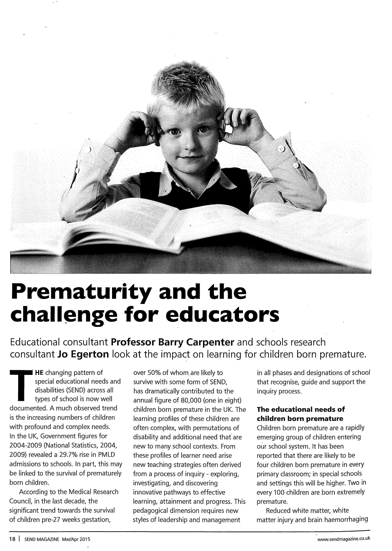
This article may guide and refresh thinking around how we engage children whose learning pathways are different due to prematurity of birth.
Professor Barry Carpenter CBE,OBE,PhD.
September, 2018
Prematurity and the challenge for educators, SEND Magazine Article 2015

 Barry Carpenter Education