
by Dr Rona Tutt and Paul Williams . Foreword by Professor Barry Carpenter.

by Dr Rona Tutt and Paul Williams . Foreword by Professor Barry Carpenter.
Girls and Autism. Educational, family and personal perspectives edited by Barry Carpenter, Francesca Happe, Jo Egerton, London/New York, Routledge, 2019 – in the Journal of Mental Health.
David Rawcliffe writes “Here is a missing piece of the puzzle of autism. A strength of the book is the way that the editors have drawn from experts who write from their own experience and research.”
Click here, or the icon below to read the full review below

These guides have been designed to help practitioners to use the materials in the BBW series, that deal with so many emotional issues, to use the books quickly, purposefully and effectively.
To find out more go to https://booksbeyondwords.co.uk/shop
“This book clearly and authentically highlights the differences and difficulties autistic girls live with. Therefore, there is no longer any excuse for them to suffer [cont..]I highly recommend this book with its easy access style for reading and its honesty on all counts.”

 Today the newly published book – Girls and Autism: Education, Family and Personal Perspectives (Routledge) has been launched to the Press. Edited by Barry Carpenter, Francesca Happe and Jo Egerton, the book has already been well received by the professional press:-
“What stands out most from this new, highly informative and skilfully edited collection are the lived experiences of the contributors; presented as honest and open accounts by girls, young and adult women describing the way autism affects their relationships with the world around them… For any social worker with an interest in the life course development of girls to adolescents to young adults this book will provide a heartfelt and highly informative insight into the lives of vulnerable and often marginalised females.”
— Mark Goodman, British Journal of Social Work
“This book is essentially very positive despite the unflinching descriptions of the complexities of life and school and the barriers that exist for girls with autism. It maintains a focus on what is possible and what is achievable even with the current reality for the majority of poorly coordinated support and insufficient services. It is a highly recommended read both for parents and for professionals working in or with schools, colleges, career services, as well as the health and social care sectors.”
— Dr Rob Ashdown, Editor, PMLD Link
This has been echoed in this lived experience interview with Talia Grant , a young woman with Asperger’s syndrome , in “ The Independent “ today .
Read more at: https://inews.co.uk/opinion/comment/hollyoaks-talia-grant-autism-representation-tv-books/
On Twitter , members of the female , wrote “It’s wonderful, our community are VERY happy.”
‘Belonging’ deals with issues of Loneliness for people with Learning Disabilities.
https://booksbeyondwords.co.uk/bookshop/paperbacks/belonging

£29.99 169pp A4 photocopiable paperback ISBN 978-1-906531-76-8

Buckingham; Hinton House

Published 2016
At this time of significant focus and concern about the mental health needs of young people in Britain (as evidenced by the Heads Together campaign www.headstogether.org.uk – led by the Duke and Duchess of Cambridge), practical resources that empower teachers to create dynamic curriculum responses are very welcome. Yet again, Tina Rae provides us with such a resource.
In a well-scripted Introduction, Dr Rae scaffolds some key constructs, which build the evidence-base for the subsequent teaching and learning strategies offered in this text. I was particularly taken with her section on ‘The Importance of Positive Emotions.’ Pulling on the seminal work of Seligman, she offers a tried interpretation, in the classroom context, of hope and optimism, flow and happy memories.
Whilst the first and last may have obvious interpretations, it is the concept of ‘flow’ that struck me as having pedagogical relevance to classroom dynamics. Flow is defined as ‘a sense of deep engagement in an activity during which time passes extremely quickly and the individual is able to work at full capacity.’ Engagement is a major platform for building responsive pedagogy in this 21st century (Carpenter et al, 2015), and here the antidote of full authentic engagement in challenging, meaningful learning is pitched against anxiety arising from feelings of disenfranchisement in an alien curriculum.
“Young people are frequently flooded with anxious and negative thoughts and doubts “ states, Tina Rae, and rightly shows how this can lead to a rapid disintegration of their emotional well-being. Cognitive Behavioural Therapy (CBT), has become a popular therapy for assisting in the restructuring of thought processes, by examining the interface between emotions and our behaviours. Schools will have known of children receiving CBT to promote positive mental health, but it was something carried out by the Psychologist or CAMHS worker. There was no curriculum context for this intervention, and the key tenets were never fully articulated in terms of teaching and learning.
Through a range of photocopiable resources and activities ‘Building Positive Thinking Habits’ goes on to do just that! It confronts the negativity, particularly around self image, that pervades the teenage years of so many young people. Bombarded by destructive negative thoughts and influences from so many angles, a rapid erosion in the mental health state can quickly occur, and direct interventions are crucial. This is where activities such as NATS and PATS can be useful and relevant. How can the power of Positive Automatic Thoughts (PATS) overcome Negative Automatic Thoughts (NATS)?
All of the activities outlined would be of great value to the teachers (as part of tutor time), to SENCOs (for designing specific interventions) and for Teaching Assistants who are often delegated to implement those interventions. Ultimately the ‘Solutions-Focussed Mind’ is the key to increasing self-confidence and resilience in young people. Whilst CBT is only one approach currently available, at long last we have a resource book that explains to teachers what it is, and how it can be useful in schools as a valid, evidence-based intervention, which has a distinctive contribution to make for all Young People.
Professor Barry Carpenter, CBE, Ph.D.
International Educational Consultant September 2016
https://www.amazon.co.uk/Building-Positive-Thinking-Habits-Self-Confidence/dp/1906531765

http://www.hintonpublishers.com/isbn_template.php?isbn=978-1-906531-76-8

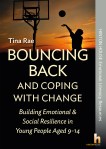
Bouncing Back & Coping with Change:
Building Emotional & Social Resilience in Young People aged 9 – 14
Author: Tina Rae, 2016
Publisher : Hinton House – www.hintonpublishers.com
ISBN:978-1-906531-68-3
Price: £29.99
This is another rich resource from the prodigious Tina Rae. Complete with CD, this book is packed full of ideas and strategies for building emotional resilience. The age range focus is helpful too, 9 – 14 years. It targets the awkward transition into adolescence, and does not lay responsibility at any particular age phase of education.
The introduction sets out the need in children for direct intervention; such shocking statistics as self-harm has increased by 68% in a decade. Rae then builds the case for resilience as a key tenet to help young people cope with change. She considers a ‘Whole School Approach’ to developing resilience and why it is important. Key approaches such as Cognitive Behaviour Therapy and Mindfulness are explained in straightforward, accessible language.
The real strength of this book, which will appeal to classroom practitioners, is the 20 sessions around ‘Bouncing Back and Coping with Change.’ The objectives for these sessions are laid out in full and clear guidance, including success criteria, given for the sessions. Each session plan is carefully constructed and accessible. As I read each one I could envisage how to teach it in practice – a true test of their viability . There are photocopiable resources to support each of the sessions.
At every juncture in the sessions there is ample opportunity for the young person to engage deeply, and reflect personally. The sessions take emotionally complex issues and bring them to daily reality in tangible, viable and practical ways. I have often wondered in recent Government proclamations on Emotional Well-Being in Children, what was meant by grit; now I understand thanks to the activities on ‘developing grit to succeed.’
At a time when the mental health issues of our young people are at the forefront of society and awareness, when schools are addressing new policy responsibilities in this area and building curriculum responses to the new designated area of Social, Emotional and Mental Health (Code of Practice on SEND, 2015), this book is both timely and welcome. It is a treasure trove of ideas and resources to create Mental Wealth in our young people.
Professor Barry Carpenter, CBE. May 2016
The latest edition of ‘Specialworld’ contains a review of “Engaging Learners with Complex Learning Difficulties and Disabilities” found on page 53. The publication can be found here.

 Barry Carpenter Education