Of late there has been a renewed interest in FASD, and the consequences for both Children’s Services and Schools.
The article below may make a helpful contribution to those discussions. Click the article thumbnail to view.
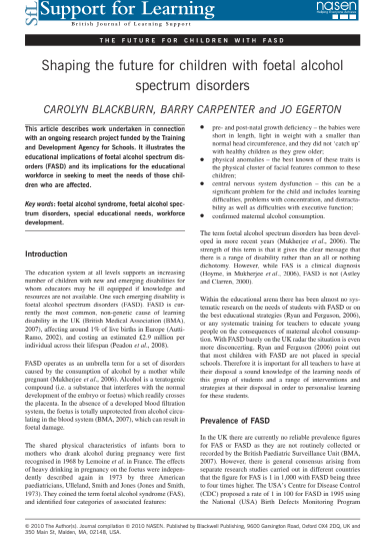
Of late there has been a renewed interest in FASD, and the consequences for both Children’s Services and Schools.
The article below may make a helpful contribution to those discussions. Click the article thumbnail to view.
Teachers often need and appreciate brief, teacher-friendly summaries of relevant research in the field of Autism. The University of Portsmouth autism network posts helpful newsletters on different topics, covering research that can inform evidence based practice and interventions that are systematically trialled.
Take a look through the below weblink.
http://www.port.ac.uk/department-of-psychology/community-collaboration/autism-research-network/
After all the debate and politically driven ideology about teaching reading only via Phonics , this article reminds us powerfully why we teach reading , and how holistic approaches are probably more successful with children with SEND.
A child’s first experiences with books and stories, paper and crayons build the foundation for language, reading and writing.
“Teaching language and literacy via the use of books demands the highest quality teaching. This in turn requires knowledge, insight and curiosity about how children learn and develop alongside their unique interests and needs,” writes Kathryn Solly. Kathryn explains how children with SEN can become inspired about books and reading.
https://www.communityplaythings.co.uk/learning-library/articles/inspiring-reading?source=pal178
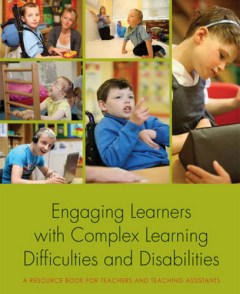
Engaging with children and young people with severe or profound and multiple learning disabilities.
Click cover image below to open and view article in full.

Engagement Profile and Scale in a SEN Specialist School
Click to thumbnail image, or link above to download, and view in full

Autism in Girls
An article from the Times Educational Supplement reporting the National Conference organised by the Girls with Autism Forum (NAHT) January 27th, 2017.
Click article image below to view in full.

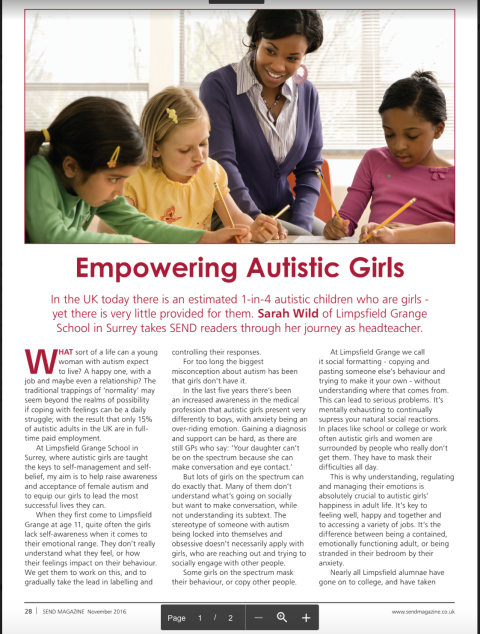
This new article by Sarah Wild, Headteacher of Limpsfiled Grange school Surrey, looks at strategies for empowering girls on autism spectrum.
Click image below to view full .pdf
New article: ‘Let’s Talk Autism’ -a school-based project for students to explore and share their experiences of being autistic
Kathryn Stevenson, Katie Cornell and Vivian Hinchcliffe
Understanding what autism means on a personal level can be an important process for young people on the autistic spectrum, and being able to reflect on this and discuss with autistic peers can be particularly helpful. However, opportunities may be restricted by reluctance to talk about diagnosis and because of difficulties in communication inherent in autism. This article describes a therapeutic media project within an ASD school that attempted to support young people to reflect together about what autism meant for them and create resources to share with others.
The process is described and main themes of discussions analysed using thematic analysis. Main themes emerged of making sense of diagnosis, experiences of difference and transition to adulthood. Various strategies to manage diagnosis and negotiate identity also emerged. Issues around informed consent and confidentiality and the therapeutic value of such groups are discussed.


 Barry Carpenter Education